Every client's returns. One login.
Your techs should not need a separate account, a separate card, and a separate password reset for every company they offboard for. Link your clients once, then run a return for any of them without leaving your own dashboard.
Volume pricing, no contracts, no minimums, no per-seat fee.
- Northwind Trading3 IN FLIGHT
- Contoso Health1 IN FLIGHT
- Fabrikam Legal0 IN FLIGHT
- Tailspin Logistics2 IN FLIGHT
Trusted by hundreds of IT and HR teams at brands such as:







Offboarding for other people is its own problem.
You already own the endpoint. Getting it back is the part that lands on a tech.
A separate account per client
One login for each company you offboard for, each with its own password, its own card on file, and its own place to forget a return was ever started.
Asking the client to place it
The alternative is emailing the client to log in and do it themselves — which puts your ticket back in their queue and your SLA in their hands.
No view across the book
Nobody can answer “how many devices are out right now, across every client” without opening a dozen tabs and adding it up by hand.
What you get
One login, every client
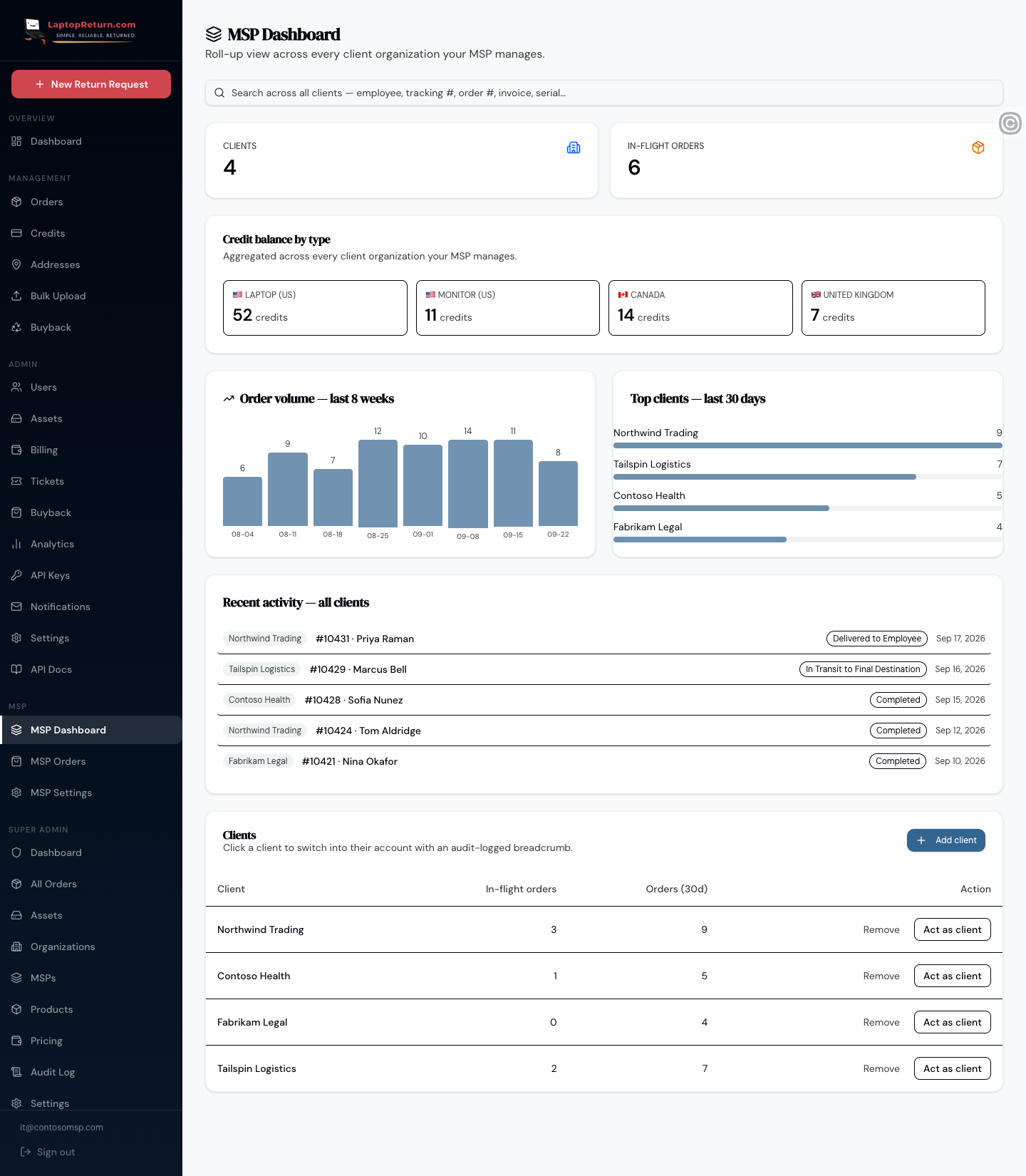
Your dashboard lists every client you are linked to, with their in-flight orders and credit balance beside them. Access is scoped to the clients you actually hold.
We talk to the employee, not you
Act as a client from your own dashboard, submit the return, and then stop. We chase the employee by email and SMS, field the replies, and only come back to you when it is something we genuinely cannot resolve. The whole point is to take the load off your techs.
One credit pool, not one per client
You buy credits centrally and draw them down across every client you manage. One balance, one invoice, one place to top up — and the dashboard still shows you where that balance is currently sitting, client by client.
Getting set up
We link your clients for you. Tell us which companies you offboard for, and we connect them to your account — each link is recorded, and a client belongs to one provider, so there is no question later about who holds an account.
Billing is central. You buy credits once, against your account, and spend them on whichever client needs a return — you are not opening a card for each company or reconciling four invoices. Your first return is free, on your first client, and there is no contract, no minimum, no per-seat fee and no platform charge on top.
What happens when it doesn’t come back?
A credit is spent when the kit ships, not when the device arrives. So the honest question is what we do to stop that being wasted — and what you can show your client when it happens anyway.
You can cancel before it ships. Every request has a window before the kit is collected, and cancelling inside it returns the credit to your pool. The length depends on when the request went in relative to that day’s pickup.
Before the box goes out, the employee gets a link to confirm or correct their address. A stale address is the single most common reason a return has to be changed, and catching it during the send delay is the difference between a credit spent and a credit wasted.
After it goes out, we chase. Email and SMS on a schedule, replies handled by us, every message kept. If the device still never arrives, you have a complete record of what was sent, when, and what came back — which is exactly what your client asks for when they audit the program. A return that failed with a full paper trail is a very different conversation from one that just went quiet.
You set the price your client pays.
Credits get cheaper as your volume goes up. What you charge your clients for a return is entirely your call — we never see it, and we never quote them. The difference is yours to keep.
Which means this is a line item you can put on an invoice rather than a cost you absorb. The more offboarding you run across your book, the lower your per-return price goes and the wider that gap gets — at real volume it is a serious margin, not a rounding error.
It also has to be a number you can put in front of a client without wincing. Nobody recommends a return program that costs a meaningful fraction of the device it is recovering — that is how these programs get quietly shelved. Ours is priced to be recommendable.
Bill it per return, roll it into a per-seat management fee, or bundle it into onboarding and offboarding as a service. We have no opinion and no rules about it.
Your rate is not the public one. We set it against the monthly volume you expect across all your clients, not per client and not per project, and it sits below the tiers listed on our pricing page. Tell us roughly what you think you will run and we will put a number in writing.
Try it on one client.
Pick the client who offboards most and run their next return through us. If it does not save your tech the afternoon, you have spent nothing.