A product designer’s last day was three weeks ago. HR closed the case after the exit interview and the final paycheck. IT learned about the departure nine days later from a manager’s ticket, then emailed HR asking for a home address. HR replied that the laptop is IT’s equipment. The MacBook is still checking in to Jamf from an apartment in Denver.
Both teams did their jobs. Nobody owned the laptop.
Who is responsible for laptop returns, HR or IT?
By default, neither, and that is the problem. HR owns the departure, the home address and the employee relationship. IT owns the device, the serial number and the wipe. A laptop return needs all six, so it falls between two teams that each hold half. Name one owner for the whole handoff and measure them on one number: devices recovered within 30 days of the last day.
Why does IT find out late?
Because the termination lives in the HRIS and the device lives in MDM, and nothing connects them. IT hears about a departure from a ticket, a message from a manager or a laptop that stops checking in. Then IT goes back to HR for the address, because the employee’s work email is already disabled.
This is normal, not a failure of either team. In the 2026 Workforce Transition Benchmark from Onwards HR and SHRM, 40 percent of organizations named cross-functional coordination as an offboarding challenge, and 66 percent use two or more tools to manage a single separation. Every tool boundary is a handoff. Every handoff is a place where a laptop waits.
HR gets blamed for a box it was never given
In many companies HR is told it is accountable for getting the device back. Then HR is handed nothing to do it with: no serial number, no shipping label, no box and no way to see whether anything arrived. What HR does have is a former employee it is trying to treat well on the way out.
So HR sends one polite email and stops. Nobody wants to hound someone who was just laid off or managed out over a laptop. IT reads that silence as HR dropping the ball. HR reads IT’s follow-up as IT pushing its job onto them. The device sits in a closet while two teams argue about whose turn it is.
Account closed is not the same as device returned
IT usually considers the exit contained once the accounts are shut off. That is containment, not recovery, and often not even containment. ShareGate’s 2026 survey of nearly 1,800 IT professionals found that 38 percent of organizations left former employees or guests with access they should have lost.
The device side is worse because it is harder to see. Flexera’s 2025 State of ITAM report found that complete visibility across the technology stack fell to 43 percent, down from 47 percent the year before. A locked MacBook in an ex-employee’s home still holds your data and still sits on your depreciation schedule. If your exits run through two teams and two systems, you already have devices in this gap. The only question is how many.
What does a handoff nobody can drop look like?
It has one owner and one record that both teams can read. Audit your process against five tests.
The return starts from the HRIS termination, the same day the account is disabled, not when someone remembers to file a ticket. The shipping address comes from the HRIS record, not from an email thread between departments. The employee gets a prepaid box at their door, so HR never has to ask twice. Carrier scans and receipt confirmation are timestamped by a third party and visible to HR and IT at the same time. A wipe certificate closes the record against the serial number.
When those five hold, there is nothing left to argue about, because the status is on the record instead of in someone’s inbox. It also works: across our last 8K+ returns, over 96 percent of laptops came back. That same record is what an auditor samples, which we covered in What Your Auditor Will Ask for When a Laptop Leaves.
The takeaway
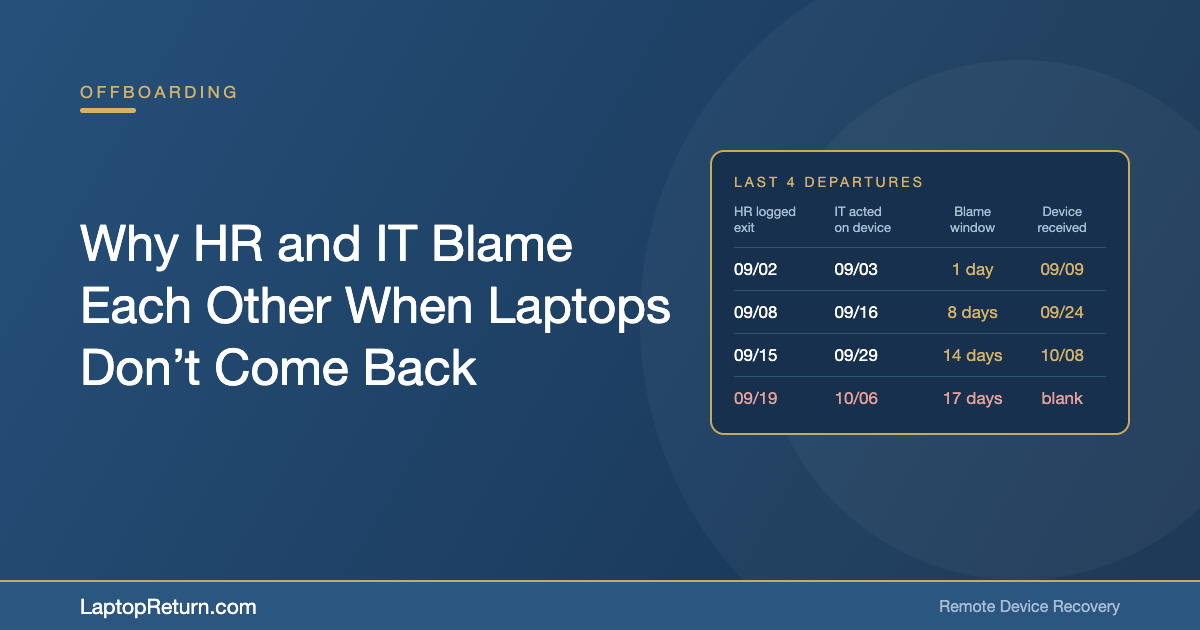
The blame is a symptom. The cause is a handoff with two half-owners and no shared record. Run this test on your own data: pull your last ten departures and, for each one, write down three dates. The day HR entered the termination. The day IT first acted on the device. The day the device was received. The gap between the first two dates is your blame window. Every blank in the third column is a laptop nobody owns.
If you would rather not build this in-house, this is the work we do at LaptopReturn.
FAQ
Who is responsible for laptop returns, HR or IT?
By default, neither owns the whole job. HR owns the departure, the address and the employee relationship. IT owns the device, the serial number and the wipe. Name one owner for the full handoff, from termination to wipe certificate, and measure them on devices recovered within 30 days of the last day.
Why does IT find out about departures late?
Because the termination lives in the HRIS and the device lives in MDM, and nothing connects the two. IT hears from a ticket, a manager’s message or a laptop that stops checking in. Tying the device return to the HRIS termination record removes the wait.
How do you stop HR and IT blaming each other for missing laptops?
Give both teams the same record. Start the return automatically when the termination is entered, ship a prepaid box to the employee’s door, and log third-party timestamps and the wipe certificate against the serial number, so either team can see where every device is.