A new hire starts Thursday. The laptop meant for them is still in the home of someone who left five weeks ago. Your IT admin has sent three reminders, asked HR for a new address and bought a replacement to make the start date. The return shows up in the budget as a $25 shipping label.
That label is the smallest number in this story.
Is it cheaper to handle laptop returns in-house?
On the shipping invoice, usually yes. In total, often no. Materials and postage are only about $60 a return. Staff time and devices that never come back are the larger lines, and they rarely appear in the same budget. In-house wins clearly only at very low volume or when departing staff can reach an office.
The $60 comes from the line-item comparison we published in 2023: a $27.95 box, $9 to $12 outbound, $22 to $25 back, plus a battery sticker and tape. Those prices have moved since, but the shape has not. If you are comparing a vendor quote with this number, you are comparing it with the wrong number.
Where do the hours go?
They go to the follow-up, not the shipping. Someone finds a home address, because the work email is already off. Someone buys the box and the labels. Someone sends a reminder, checks a tracking page, updates a spreadsheet and sends another reminder. No single step is big enough to get its own ticket, so none of it is measured.
Your own hours are the number to find, so treat ours as a placeholder: four hours a week for a small IT team. The work stays manual in most companies. BetterCloud’s 2026 State of SaaS Report found only 27 percent of organizations automate offboarding at all, and that is before anyone has to physically move a laptop.
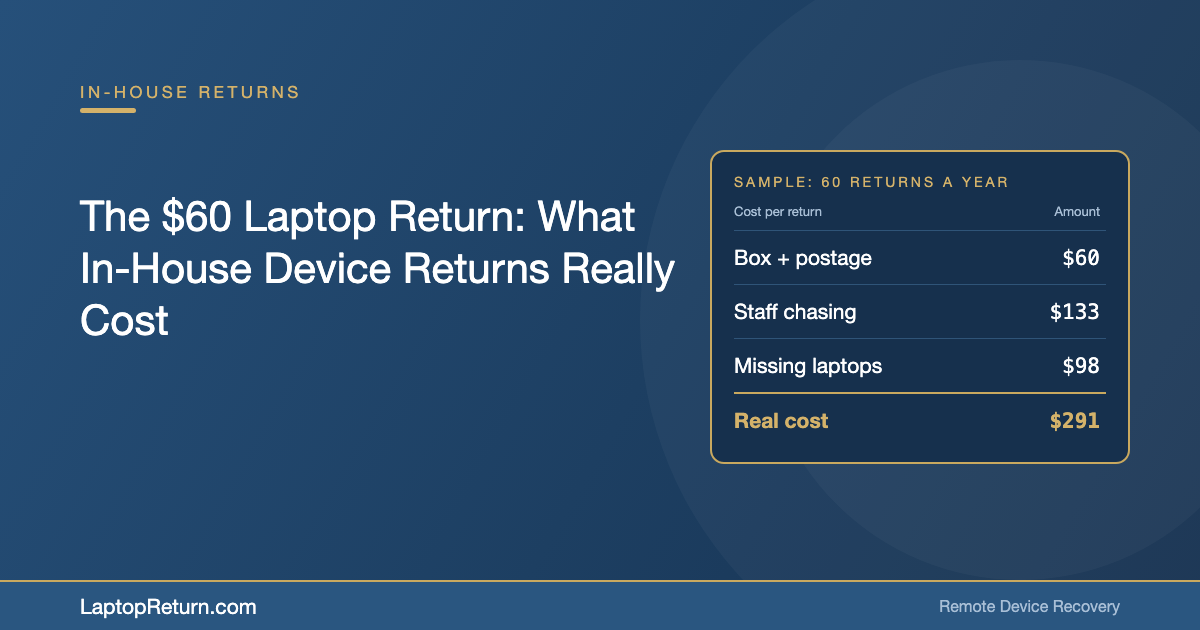
Run the math on a modest case. Take 60 returns a year and four hours a week at the $40 hourly rate from our 2023 comparison. That is $8,000 a year, or about $133 per return. Your labor line is already more than twice your materials line.
The missing laptop belongs in the same budget
Unreturned devices are usually written off somewhere else, which is why the in-house number looks clean. They should sit on the same sheet, because they are an outcome of the same process.
Capterra’s 2022 Employee Offboarding Survey, published in 2023, found 71 percent of HR workers had at least one departing employee keep company equipment, with an estimated $1,963 walking out per employee. Teqtivity’s Q2 2026 Asset Intelligence Report models unreturned rates of 5 to 15 percent.
Use the low end. Five percent of 60 returns is three devices, or $5,889. Spread across all 60, that adds $98 per return. Our example now reads $60 for materials, $133 for labor and $98 for missing hardware: $291 per return, before anyone counts data exposure. These are sample inputs, so swap in your own. The structure is the point.
Why the rebuy line is getting worse
The fourth cost is the laptop you bought because the old one was still in transit, or still on a shelf in someone’s apartment. It is a timing cost, and teams feel it most when hiring runs alongside departures. A device that comes back six weeks late can still be redeployed, but the replacement has already been paid for.
That purchase got more expensive this year. Gartner estimated in February 2026 that memory costs would push PC prices up 17 percent over 2025 levels, and that business buyers would keep PCs 15 percent longer. Every recovered laptop is now worth more, and it is more likely to go back into service instead of being retired.
What should a real in-house process pass?
Whoever owns returns, hold the process to four tests. Does the return start from the termination record, without anyone remembering to file a ticket? Does a prepaid box reach the employee’s door, so nobody has to ask twice? Are carrier scans and receipt timestamped by a third party, not typed into a spreadsheet? Does a wipe certificate close the record against the serial number?
If you pass all four with little staff time and few missing devices, in-house may be the right call, especially at low volume. For scale, across our last 8K+ returns, over 96 percent of laptops came back.
The takeaway
Postage is the part of a laptop return that is easiest to see, not the part that costs the most. Test it on your own data. Take the last twelve months and add four numbers: box and postage spend, staff hours multiplied by a loaded rate, the replacement value of every device still out, and the laptops you bought while a return was pending. Divide by completed returns. That is your real cost per return, and the only figure worth comparing with an outside quote.
If you would rather not build this in-house, this is the work we do at LaptopReturn.
FAQ
Is it cheaper to handle laptop returns in-house?
On the shipping invoice, usually yes. In total, often no. Materials and postage run about $60 a return, but staff time chasing employees and the cost of devices that never come back are bigger lines. In-house is cheapest only at very low volume or when departing staff can reach an office.
What costs are missed when calculating in-house laptop returns?
Three lines rarely reach the budget: staff hours spent getting addresses, sending reminders and tracking shipments; the value of devices that never come back; and new laptops bought for incoming hires because a returned device has not arrived yet. Add them to materials and postage before comparing.
How do you calculate your real cost per laptop return?
Add twelve months of box and postage spend, the hours staff logged on returns multiplied by their loaded rate, the replacement value of unrecovered devices, and laptops bought while a return was pending. Divide the total by completed returns. Compare that number, not postage, with any outside quote.